
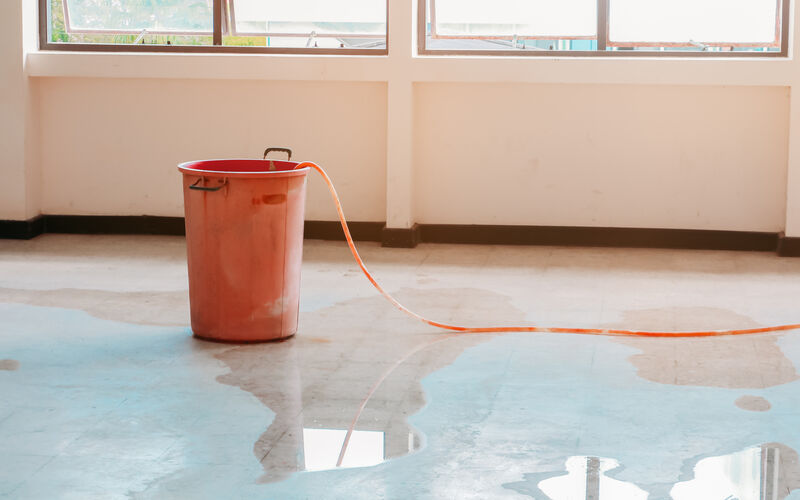
If you own a home in Las Vegas built between 1980 and 2010, there's a real chance you'll deal with a slab leak at some point. The combination of expansive soil, hard water, and copper pipes embedded in concrete is hard on plumbing — especially the hot-water lines. Over 20+ years of finding leaks across the valley, we've narrowed the diagnostic process down to seven warning signs. If you have any combination of three or more, call us at (702) 682-1626 — we'll walk you through what to do next, free.
What's a slab leak?
A slab leak is a leak in the water lines that run UNDER your home's concrete foundation. Most happen on the hot-water side because heated copper expands and contracts against the concrete and gravel, eventually wearing through the pipe wall. Cold-side slab leaks happen too — usually from pinhole pitting or external corrosion.
1. A warm or hot spot on the floor
Hot-water slab leaks are the most common type. As the water escapes the pipe, it heats up the concrete and whatever's above it — tile, carpet, hardwood. Walk around your home barefoot. If you find an unexplained warm spot — especially in a hallway, bathroom, or kitchen — it's almost always a slab leak.
Bonus diagnostic: do this in the morning before the floor has any sun warming it. If you find a warm spot at 7 AM with no sunlight on it, that's a near-certain indicator.
2. The sound of running water when everything is off
Stand still in your house and turn everything off — sinks, ice maker, washer, irrigation. If you hear water running anyway, somewhere in your walls or under the floor, that's a leak. Put your ear to the floor near where the sound is loudest. You're listening for a hiss, a rush, or a steady gurgle.
This sound is louder at night when ambient noise is lower. If you wake up at 2 AM and hear water running, don't dismiss it — that's how a lot of our customers discover their slab leak.
3. A water bill that spikes for no reason
A continuous slab leak can waste 50-200 gallons per day. That adds up to a $100-$400 unexpected bill increase per month. If your bill suddenly jumps — and you haven't filled a pool, planted a lawn, or had guests — start investigating immediately.
Check your meter: shut off all water in the house and watch the meter dial. If it's spinning, you have a leak somewhere on your side of the meter. We cover this in detail in our High Water Bill Investigation service.
4. Mildew smell or visible moisture along baseboards
Water from a slab leak follows the path of least resistance, often migrating sideways through gravel and emerging at the perimeter of your home — usually along baseboards or at floor-to-wall joints. If you smell mildew that wasn't there before, or see staining/bubbling at the base of walls, the source is often a slab leak.
5. Cracks in floor tile or grout
Long-running slab leaks soften the soil under the slab and cause uneven settling. The visible result is cracking — particularly hairline cracks in tile grout that suddenly appear or get worse. Same goes for vinyl plank or laminate flooring that starts to buckle.
6. A reduction in hot water pressure
If your shower or kitchen sink hot water suddenly has less pressure than cold (or less than it used to), that's a sign water is escaping the hot line before reaching the fixture. This is one of the most overlooked indicators because people assume it's the water heater. It's often the slab.
7. The water heater runs constantly
Your water heater's job is to maintain temperature in a closed system. If hot water is escaping under your slab, the heater has to keep reheating because the system is constantly losing heat. You'll notice the burner cycling on more often, higher gas/electric bills, and sometimes a hotter-than-normal water heater closet.
What to do if you suspect a slab leak
Don't panic. Slab leaks are very fixable, and modern detection means we can find them precisely without breaking up your floor.
- Confirm with the meter test. Shut everything off. Watch the meter. If it moves, you have a leak.
- Take photos. Document warm spots, moisture, and any visible damage for insurance.
- Call us. (702) 682-1626. Phone consultations are free. We'll tell you whether what you're seeing is likely a slab leak before we drive out.
- If it's confirmed and active, we can usually pinpoint and repair on the same visit — most jobs leave 95%+ of your floor intact.
"We dread slab leaks because they sound scary. But honestly — by the time we leave, most homeowners are surprised how minor the work actually looks. We open a small spot, fix the leak, and patch. The hardest part is finding it. That's what we're good at." — Matt, owner
Don't ignore it — slab leaks get worse
Every day a slab leak runs, it's wasting water, costing you money, and softening the soil under your foundation. The longer you wait, the bigger the cleanup and the higher the risk of structural damage. If three or more of the signs above match your home, call (702) 682-1626 today.