
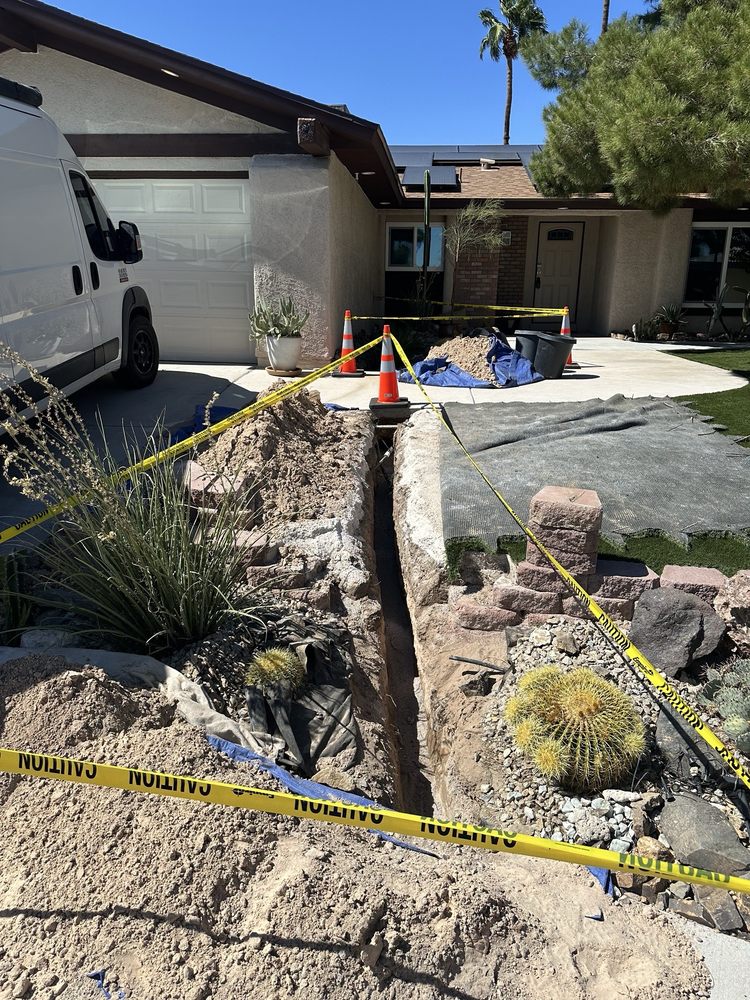
Most homeowners have never seen a slab leak repair done. The mystery makes it feel scarier than it is. Here's a walkthrough of a recent job in Henderson, with detail at each step so you know what to expect.
The call
Customer called us at 8:30 AM. Symptoms: warm spot on the master bathroom floor (felt it barefoot at 7 AM, no sun on the floor), water bill jumped from $90 to $290 last month, and a faint "running water" sound at night.
On the phone, we walked through the diagnostic. Warm spot + bill spike + audible water = near-certain hot-side slab leak. We quoted a price range of $1,200-$1,800 for detection + single-spot repair if it was straightforward, and dispatched a tech for 11 AM same-day.
Step 1: Assessment (11:00 AM)
Walked the bathroom with the homeowner. Confirmed:
- Warm spot 4 feet from the toilet, in the floor
- No visible water on the floor
- Hot water pressure at the sink slightly lower than cold
- Water heater running more than usual
All consistent with a hot-side slab leak in the bathroom branch line.
Step 2: Pressure isolation (11:15 AM)
Shut off the hot water at the heater. Watched the meter — it slowed significantly. That confirmed the leak was on the hot side. Re-opened hot, shut off cold — meter movement was minimal. Hot-side slab leak confirmed.
Time to find it.
Step 3: Acoustic detection (11:30 AM)
Brought out the ground microphones. Started sweeping the bathroom floor in a grid pattern from the warm spot outward. Heard a clear hissing signal centered about 14 inches from where the warm spot felt strongest — water had been migrating through gravel and concrete to that location.
Cross-swept from a perpendicular angle. The two loudest spots intersected at a single point.
Marked the spot with a small X using painter's tape. The leak was 6 inches under the tile.
Step 4: Electronic line trace (11:50 AM)
Used the electronic line tracer to confirm the pipe path. The hot supply line ran exactly where we expected — under the master bath, branching off the main hot supply riser in the wall. The leak point was directly on that path. Confidence: high.
Step 5: Discussed options with homeowner (12:00 PM)
Three options, presented honestly:
- Single-spot repair through the tile floor: $1,200 estimated. Would damage 2-3 tiles, requires homeowner to handle tile replacement after.
- Re-route through the wall: $1,500 estimated. Floor untouched. New PEX line snaked through the wall from the supply riser to the bathroom fixture, abandoning the slab pipe.
- Wait until later: Free. But leak is wasting 80+ gallons/day and water damage is accumulating.
The homeowner chose re-route because the tile was a custom pattern they didn't want to disturb.
Step 6: Re-route execution (12:15 PM - 4:30 PM)
- 12:15 PM: Shut off water at the main. Drained the hot supply.
- 12:30 PM: Opened a 6"x10" patch in the wall above the bathroom vanity, exposing the supply riser.
- 1:00 PM: Snaked new PEX-A from the vanity supply, up through the wall cavity, across the ceiling, and down into the bathroom fixture chase.
- 2:30 PM: Connected new PEX at both ends with expansion fittings. Capped the abandoned slab pipe at the riser.
- 3:00 PM: Pressure tested at 100 PSI for 30 minutes. No drop. Leak path confirmed isolated.
- 3:30 PM: Restored water. Verified hot water at the bathroom fixtures.
- 4:00 PM: Patched the wall opening with new drywall. Taped and floated. Notified homeowner that paint/texture would be needed after the patch dried (recommended professional painter).
- 4:30 PM: Cleanup. Walk-through with homeowner.
Step 7: Documentation
Provided the homeowner with:
- Written leak report with location, cause, and repair scope
- Photos: before, during, after
- Acoustic readings showing the original leak signature
- Pressure test results
- Invoice with 1-year workmanship warranty on the re-route
Everything the customer needed for insurance documentation (their carrier ended up covering 70% of the cost).
Step 8: Follow-up (one week later)
Called to check on the repair. Floor was no longer warm. Water heater was running normally. Bathroom hot water pressure was normal. Wall patch ready for paint. Customer's next water bill came in at $115 — back to normal.
Final cost breakdown
- Detection (acoustic + electronic): $400
- Re-route repair: $1,150
- Drywall patch (basic): included
- Total: $1,550 (within the original $1,200-$1,800 phone quote)
Customer feedback (left on Google):
"Matt walked me through every step. No surprises. The price he quoted was the price I paid. Floor stays intact, hot water works, no more mystery warm spot. Couldn't ask for more from a contractor."
What this job shows
- Slab leak detection isn't magic — it's systematic diagnostics
- Re-routing avoids tile damage when that matters
- Most slab leak jobs are done in a single visit
- Honest pricing on the phone leads to honest pricing on the invoice
- Documentation supports insurance claims
If you suspect a slab leak in your home, call (702) 682-1626. Free phone consultations. See our Slab Leak Detection service page for full details.